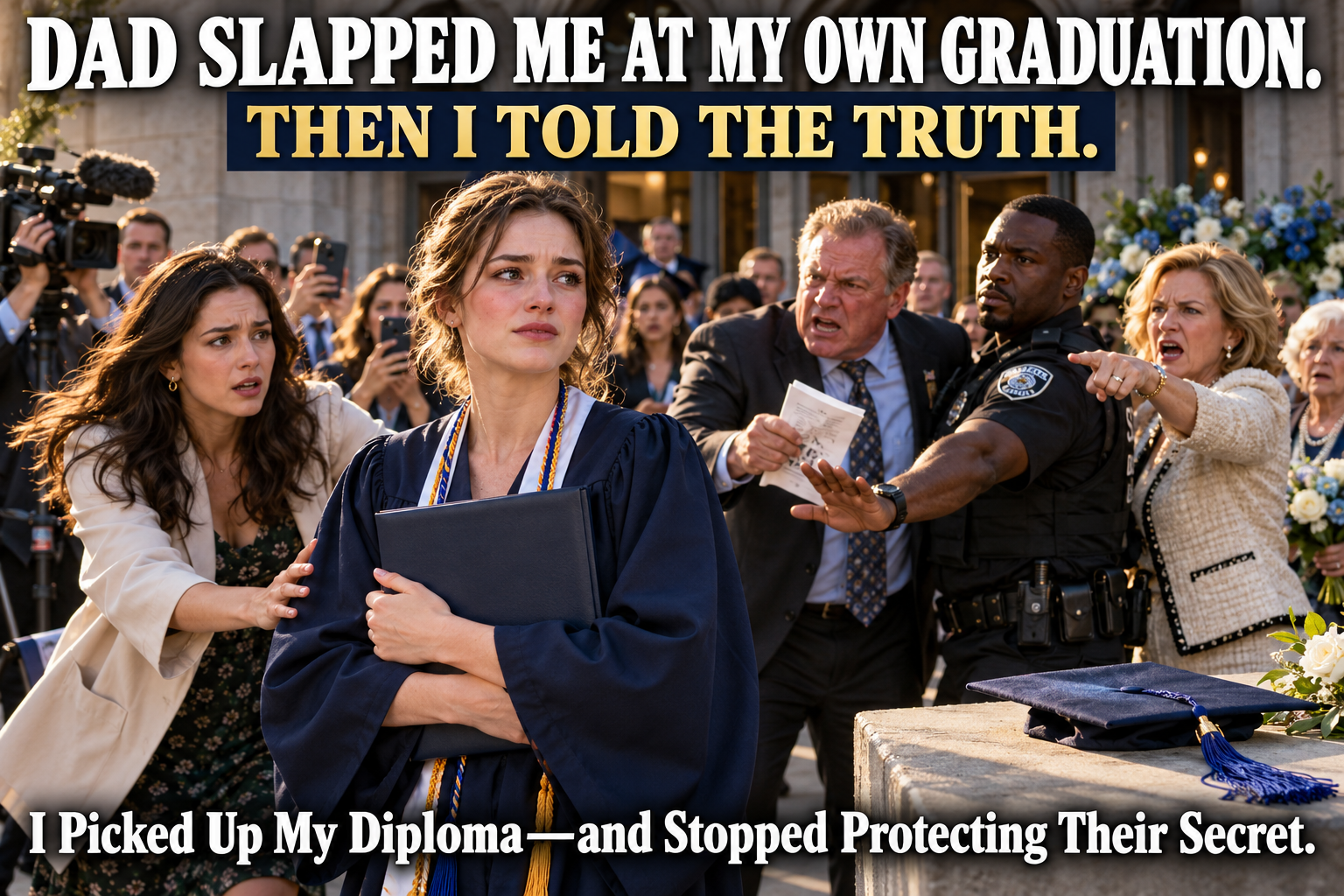
At my graduation, Dad slapped me so hard my cap fell. Mom called me a failure while cameras kept recording. I picked up my diploma and said, “Good. Now you’ll all hear the truth.” They had tried to stop me attending—and it wasn’t because they doubted my degree.
Part 1
My cap landed beneath the folding table where families were arranging flowers for photographs.
For one second, I could see only the blue tassel against the concrete.
Then the pain reached my cheek.
“You don’t deserve that degree,” my father spat.
He stood inches away, red faced, holding the program he had crumpled while searching for my name. Behind him, my mother pushed through the crowd.
I thought she might finally stop him.
Instead, she pointed at me.
“You’re just a failure in a gown!”
Conversations around us fell silent. A woman holding a bouquet stepped back. Someone’s phone remained raised, recording the congratulations that had turned into something else.
My diploma folder lay beside the table. I had dropped it when Dad struck me.
I was twenty-three, wearing a navy graduation gown, standing outside the auditorium where I had just received my civil-engineering degree. Four years of classes, night shifts, borrowed textbooks, and working through problems after my roommates went to bed had brought me to this moment.
My parents had tried to keep me from attending.
Now I understood that arriving anyway had frightened them more than they could hide.
Dad reached toward my arm.
A campus staff member stepped between us.
“Sir, move back.”
“This is my daughter.”
“Move back.”
The woman spoke plainly, without asking him to explain why he had hit me. Another staff member called for security.
I bent to pick up the folder.
My hands were steady. That surprised me. For years, I shook whenever my father raised his voice. Now there were people around us who had seen what happened, and I did not have to explain why I was frightened before being allowed to move away.
My friend Nina retrieved my cap.
“Emma,” she said softly, “come with me.”
“In a minute.”
I turned toward the cameras. There was more than one now: a student’s phone, a parent’s phone, and a local news camera that had been collecting graduation interviews near the doors.
I did not know which would keep recording or where the footage would go. I knew my parents could no longer pretend there was no degree, no ceremony, and no daughter standing in front of them.
I smiled. It was not happiness. It was the strange relief of no longer trying to keep their version of me alive.
“Good,” I said. “Now you’ll all hear the truth.”
My mother’s pointing hand fell.
“Don’t,” she whispered.
She did not sound angry anymore.
Dad stared at me.
“You’ll regret this.”
“I regret waiting.”
Security arrived. One officer asked whether I needed medical attention, and I said I wanted to be checked and to give an account of what happened. He guided us farther apart before anyone resumed the argument.
I held the diploma folder against my chest.
Then I looked at my parents and said the sentence they had spent the last year trying to prevent anyone hearing.
“I finished this degree while you told people I was too sick to leave my bedroom.”
Across the crowd, an older woman lowered her bouquet.
“I donated to that appeal,” she said.
Part 2
Until my second year at university, I believed my parents were merely disappointed in me.
Disappointment was the language of our house. My brother, Daniel, earned approval by being practical, working for Dad, and not asking questions about money. I earned lectures by wanting a career neither parent understood well enough to control.
“A degree won’t make you better than us,” Dad told me when I received my acceptance.
“I never said it would.”
“Then stop acting like it.”
My mother asked who would pay.
I had a partial scholarship, savings from summer jobs, and an offer to work on campus. I showed her the numbers. She looked at them briefly, then told me people failed all the time after thinking they had a plan.
I went anyway.
My parents were Richard and Elaine Collins, familiar names in our small town. Dad ran a building-supply business. Mom organized charity dinners and school fundraisers. They were the couple people thanked for arranging tables, collecting donations, and knowing which neighbor needed help.
At home, help was something they said they had already given too much of.
When I needed money for a textbook, Dad reminded me I had chosen independence. When I came home for a weekend, Mom asked whether I had been eating properly, then complained that I looked tired enough to embarrass her.
I stopped coming often.
That did not stop them using old photographs of me at family events. Mom posted pictures from school ceremonies and described me as a daughter working through difficulties. I assumed she meant our arguments.
Then, one summer, Mrs. Avery stopped me outside the pharmacy.
She had known me since I was little. She carried a shopping bag and looked astonished to see me standing there.
“Emma. You look so well.”
“Thank you.”
“I’m glad the treatment is helping.”
“What treatment?”
She hesitated.
“The appeal your mother organized.”
I stared at her.
She saw my confusion and took out her phone. A page showed a photograph of me at fifteen, lying against pillows after a routine operation. I remembered the picture because I had asked Mom not to post it even then.
Above it were the words HELP EMMA RETURN TO LIFE.
The description said I had withdrawn from university after a severe health crisis. It said I rarely left home, needed extensive support, and faced expenses the family could not manage alone.
I was standing outside a pharmacy with a bag of shampoo and an exam timetable in my pocket.
“I’m at university,” I said.
Mrs. Avery looked from me to the screen.
“Your mother said…”
“I know.”
I did not know yet, but I needed her to stop repeating the description long enough for me to breathe.
She gave me the page address and asked whether she should contact Mom.
“No. Please let me find out what happened first.”
At my rented room that evening, I opened the appeal.
There were donations, comments, and updates written in my mother’s voice.
People had given more than a hundred thousand dollars.
The most recent update was dated two days before I passed an important engineering assessment.
It said I had suffered another setback and could no longer manage ordinary daily tasks.
Part 3
I called my mother.
She answered cheerfully, asking whether I remembered a family dinner planned for Sunday.
“What is Help Emma Return to Life?”
Her voice changed.
“Where did you see that?”
“Online.”
“Who sent it?”
I thought of my father asking that same question whenever information reached me before he approved it.
“What is it, Mom?”
“A way people can help.”
“Help who?”
“Our family.”
“You said I left university.”
“You have been struggling.”
“With deadlines and money. Not what you wrote.”
She sighed.
“You don’t understand how these things work.”
“Then explain.”
She tried several explanations. The language was intended to make people understand the pressure we were under. Some expenses involved the household, which indirectly supported me. Donations were voluntary. Nobody had forced anyone to give.
None answered why she told people I could not leave my bedroom.
“Take it down,” I said.
“We can’t just stop. There are commitments.”
“What commitments?”
“Talk to your father.”
He called an hour later.
“You will not embarrass your mother.”
“She’s using my name.”
“We raised you. We’ve paid for things you’ve forgotten.”
“Then give people an accurate account.”
He lowered his voice.
“If you make accusations, nobody will pay your rent again. Don’t come to us when that scholarship doesn’t cover enough.”
They were already contributing almost nothing, but the threat reached the part of me that still hoped help might come if I asked correctly.
I ended the call shaking.
Nina found me sitting on the floor beside my bed.
She lived in the room across the hall and had become the person who knew when I had not eaten or slept enough. I showed her the page.
She read it quietly.
“Emma, we need someone who knows what to do.”
“I don’t want everybody looking at me.”
“They’re already looking at a version of you that isn’t real.”
That night, Nina made toast while I tried to remember whether I had ever agreed to anything that could be mistaken for permission. I searched the messages I had sent Mom about school. There were exam dates, requests for a ride, and a photograph of a model I built. None described the life in the appeal. Nina asked me to stop reading for ten minutes and eat. I did, though the first mouthful felt impossible. I had been taught to doubt my memory whenever my parents sounded certain. The written messages helped me hold onto what I actually knew, and the toast reminded me I still had ordinary needs.
The next day, I spoke with a student adviser. I brought screenshots, the public page address, and records showing my enrollment. I did not ask the university to make a dramatic announcement. I asked for help understanding my options and protecting the truth about my own life.
The adviser referred me to appropriate support, including someone who could explain the legal and financial concerns. We worked carefully, preserving the original material and separating what I knew from what needed investigation.
I was not going to decide every donation was traceable to one purchase because I saw Dad drive a different car. I needed records rather than a story that merely felt plausible.
The fundraising service received a report through its proper process. Questions were raised about the claims and my lack of consent. Some material changed afterward, but the copies already preserved showed what had been said.
My mother continued telling people I was having a difficult time.
That part was true. The source of the difficulty was not what she claimed.
Then Daniel called.
“I need to show you something,” he said. “And I need you not to tell Dad I found it.”
Part 4
We met in a car park behind a grocery store because Daniel did not want to come to my room.
He was thirty, seven years older than me, with the same habit Dad had of tapping his keys against his palm while thinking. I had begun to resent that resemblance before I knew whether it was fair.
He handed me a folder.
“I was helping with the fundraiser accounts,” he said.
My stomach tightened.
“You knew?”
“I knew they were raising money because you’d had problems. I thought there were things you didn’t want to tell me.”
“I’m in classes. I’m working. You knew that.”
“Yes.”
He looked ashamed.
“I let the explanations stay separate because checking them meant asking questions Dad didn’t want.”
Before handing it over, Daniel asked whether I had eaten. The question made me angry because it sounded like care arriving after the useful decisions had been made without me. I told him I did not want to talk about lunch yet. He nodded and stopped asking. We stood beside his car while people pushed shopping trolleys past us, unaware of the conversation. I was glad we had not met at our parents’ kitchen table. There, every chair carried an old role, and I would have struggled to ask him anything without feeling like the youngest person in the room. Here, we were two adults who needed accurate answers.
I opened the folder.
There were copies of public appeal records and accounting summaries Daniel had helped prepare in the role he had been given. He explained what he could legitimately provide and what would need to be requested elsewhere. We did not treat family access as permission to take every private file.
The fundraiser had brought in approximately one hundred forty-six thousand dollars before the principal appeal was stopped for review.
Some funds had been described as reimbursements for treatment-related family expenses. I had received none of that money and had never authorized the story used to collect it.
Daniel pointed to an entry involving an upcoming charity dinner.
“They’re planning another appeal,” he said. “Different page. More careful wording.”
“What wording?”
He showed me a draft he had been asked to format.
A courageous young woman rebuilding her life after years of setbacks.
Below it were plans to show a recorded message from me.
“I never recorded one.”
“I know.”
The message was supposed to be assembled from an old family video in which I thanked my parents for helping with a school trip. The draft script around it would make it appear current.
I closed the folder.
“I don’t know how they thought this could last.”
Daniel rubbed his forehead.
“They thought you’d need them more than you’d want to stop it.”
I looked at him.
“Did you?”
He nodded slowly.
“I’m sorry.”
The apology mattered. It did not remove the time he spent helping without checking.
I told him the records needed to go to the people advising me and reviewing the appeal, with an accurate explanation of how he obtained them.
He agreed.
Over the following months, questions multiplied. The service restricted the original appeal while examining it. Event organizers asked for clarification. People connected to the family’s community work began comparing the descriptions with actual dates.
My parents did not disappear from my life. They called, wrote, and sometimes sounded almost affectionate before asking what I had told whom.
I stopped answering questions about the review outside the channels established for it.
I kept going to class.
Graduation approached with the ordinary demands of a final year. My project needed finishing. My gown needed ordering. I needed to decide who would sit in the audience.
Then Dad sent me a message.
Do not attend the ceremony. Your mother has already explained why you can’t be there.
Part 5
I read the message in the university library.
Around me, students whispered about exams and packed books into bags. One woman was deciding whether to invite both of her divorced parents to the ceremony. Another complained that her family had booked lunch too early.
Ordinary graduation problems.
I had been instructed not to attend my own.
I replied: I have earned my degree. I will be there.
Dad called immediately.
I let it go to voicemail.
He said I would be responsible if the family’s reputation was damaged. He said my mother could not cope with another public setback. He said I had no idea what I was doing.
I saved the message and went back to my project calculations.
For years, that voice could make me forget everything except finding the answer that would quiet it. Now I had a deadline more important than calming my father.
Nina sat across from me that evening while I addressed the invitation envelopes.
“Who’s coming?”
“You.”
“Obviously.”
“My aunt Ruth. Maybe Daniel.”
“What about your parents?”
“They can buy tickets through the family allocation if I choose to provide them. I haven’t decided.”
I eventually decided not to give them mine. That did not prevent them accessing the public area outside the ceremony or being present elsewhere through arrangements they made themselves.
I informed the student-support contact about my concerns and the messages I had received. We discussed practical options for arriving and leaving, and whom to contact if my parents appeared and became disruptive.
No one could promise the whole day would remain untouched. We could make sure I would not be expected to handle everything alone.
Daniel said he would come.
He also said Dad intended to attend despite telling me not to.
“Why?”
“He thinks he can talk to you before you go inside.”
“Then tell him I’m not discussing the appeal on campus.”
“I did.”
“What did he say?”
“That you’ll listen when he’s in front of you.”
The week before the ceremony, I went to collect the gown with Nina. We stood in a queue beside students discussing lunch reservations and family photographs. I tried mine on over my ordinary clothes and looked at the length in a small mirror. Nina straightened the collar without asking whether I was excited. I was, in a way that felt fragile. On the walk home, she asked where I wanted the first photograph taken. I chose the old steps near the engineering building, where I had sat after difficult exams. Having one small plan that belonged to me made the rest of the day feel less entirely controlled by what Dad might do.
I did not sleep well the night before graduation.
Aunt Ruth came early with breakfast and helped fasten the small clasp at the back of my dress. She had believed my parents’ descriptions until I called her and explained. She apologized without asking why I had not told her sooner.
I appreciated that.
“You look like yourself,” she said when I put on the gown.
For once, I did not need a relative to say I looked beautiful. I needed someone to see the person who had been there all along.
At the auditorium, I sat with other graduates and listened to names being called. When my turn came, I walked across the stage, shook the dean’s hand, and accepted the folder.
There would be administrative details and documents afterward, as there always were. The achievement did not depend on which piece of paper lay inside at that exact moment.
I had finished.
Outside, Nina raised her phone for a photograph.
That was when Dad appeared beside the folding table, my name underlined in his crumpled program.
He looked at the gown as though it were evidence against him.
Part 6
When I told the crowd my parents had said I was too sick to leave my bedroom, Dad tried to speak over me.
“She doesn’t understand the appeal.”
“I understand what you wrote.”
Mom reached toward the folder in my hand.
“Please, Emma. Not here.”
Nina stepped closer to me while security kept my father back.
I did not reveal medical records, banking details, or donor information to a crowd. I stated the facts about my own life: I had remained enrolled, completed my coursework, worked to support myself, and never consented to the fundraising story.
“The public appeal raised about one hundred forty-six thousand dollars,” I said. “I did not receive that money. The claims are being reviewed, and the people handling that process have the records.”
I could hear phones recording.
That did not mean I had suddenly acquired a courtroom. The people around us were witnesses to a confrontation, not decision-makers who could settle the finances by applauding.
Mrs. Avery pushed through the edge of the group.
She was the woman who first showed me the appeal. I had not realized she was attending for her grandson’s graduation.
“I saw Emma last summer,” she said. “She told me she was studying. I should have asked more questions.”
Mom shook her head.
“You don’t know everything.”
“Then explain it to the people reviewing it,” I said. “Stop explaining me.”
Dad’s face changed. He looked from one camera to another, finally understanding that the footage included the slap, not merely my response.
“Turn those off,” he ordered.
No one moved because he demanded it.
A security officer asked the crowd to give us space. I went with Nina and Aunt Ruth to a quieter room so I could be checked and provide an account. I preserved what I could and asked relevant witnesses to share material through the appropriate process rather than flooding my phone.
The news reporter approached carefully.
“Would you like to speak?”
“Not right now.”
She accepted the answer.
I was glad. Making one statement in a moment of anger did not obligate me to spend the rest of the day performing the injury.
A staff member brought a clean cloth and asked before touching my face. Another explained who would take my account and what could happen next. They did not ask why I had made my father angry. I noticed that absence, and it almost unsettled me more than a question would have. In our house, describing anything hurtful usually began with explaining what I said first. Here, people could start with the action they had seen. I answered as clearly as I could, correcting myself when I was unsure about the order of a detail. Nobody demanded that remembering everything perfectly was the price of being believed.
In the quiet room, my hands began shaking.
I had been steady outside. Now the shock arrived, and I sat down before my knees gave way.
Aunt Ruth placed water beside me.
Nina said nothing about being brave. She asked whether I wanted her to stay.
“Yes.”
Daniel appeared in the doorway after checking with staff.
“I saw what happened.”
“Where were you?”
“Near the doors. I couldn’t get through fast enough.”
I looked at him for a moment.
“Then tell the truth about what you saw.”
“I will.”
He did not ask me to avoid reporting it because Dad was our father.
That mattered more than another apology.
Later, he showed me a message Mom had sent him during the confrontation.
Stop your sister. She’ll ruin everything.
I looked at the time on the screen.
It was the minute after Dad hit me.
Part 7
I stared at the message until the letters seemed detached from their meaning.
Stop your sister.
Not: Is she hurt? Not: Your father needs to leave. Not even a frightened request to end the argument so somebody could check on me.
My mother had watched an assault and identified my voice as the emergency.
Daniel saved the message and provided it where it belonged. He did not post it online to prove he was now the better sibling.
We left campus through a quiet exit after completing the immediate arrangements. Nina carried my flowers. Aunt Ruth drove. I held the diploma folder and cap on my lap, examining the tassel as if something that small might help me stay in the afternoon.
“Do you still want lunch?” Ruth asked.
I had booked a modest table at a café weeks earlier. I almost said no. Then I imagined giving the whole remaining day to my parents.
“Yes.”
We ate sandwiches at a table near the window. My cheek hurt. The flowers leaned in a water jug the café owner brought without asking why I was carrying so many.
For a while, we talked about my final project.
Nina asked me to explain the part she never understood. Daniel listened. Ruth admitted she had been nodding politely for months without knowing what a drainage model did.
I laughed, then found myself crying over the plate.
“I’m sorry,” I said.
“You don’t need to be,” Nina answered.
I had not cried in front of the cameras. That did not mean I was forbidden to cry afterward.
After lunch, we went back to Ruth’s house because I did not want to spend the first evening alone in my room. She cleared a place for the flowers and asked where I wanted to put the cap. I chose the side table, within reach but away from the door. Nina stayed until I had changed out of the gown. Taking it off felt different from leaving it behind. I folded it carefully because it belonged to the work I completed, not to the way my parents treated me afterward. Then Ruth made tea, and I sat with the others without needing a new statement ready.
That evening, I watched none of the clips spreading online. I knew the important records were being preserved. Reading strangers’ opinions about my family would not help me sleep.
I called the adviser who had helped me through the earlier review. We discussed immediate support and the practical next steps. The assault and the fundraising issues would be handled through their respective processes. Neither became a finished case because a clip went viral.
My parents’ phones rang with questions from people who had seen the footage. I learned about that later, mostly through their messages to me.
You’ve humiliated us.
You could have kept this private.
Your mother is crying.
I saved what needed saving and did not answer.
They wanted my sympathy before offering responsibility.
Over the next week, several people connected with the appeal contacted the service, organizers, or the appropriate reviewing bodies with their concerns. The family’s planned charity dinner was paused while its claims and use of material were examined.
My parents’ reputation changed because the facts no longer matched the public story they had maintained. I did not have to invent a revenge campaign.
Then Aunt Ruth brought me a cream envelope.
“Your grandmother left this with me before she died,” she said. “I should have given it to you sooner.”
I looked at the handwriting.
It was addressed to me.
Inside was a letter and a receipt for a payment my father had always told me never existed.
Part 8
The receipt was for twelve thousand dollars.
Grandma had sent it to my parents before my first year, intending it to help with my education. Dad told me she could not afford anything and that asking would embarrass her.
I sat beside Ruth while reading the letter.
Emma, I am proud that you have chosen work you care about. I hope this takes some worry from the beginning.
Grandma died before the end of my first semester. I had mourned her while working extra shifts and believing I should not complain because she had not been able to help.
Ruth looked miserable.
“She asked me to hold the letter until you moved into your room. Your mother said she’d give it to you with the payment details.”
“Why did you keep it?”
“Elaine kept saying it was a bad time. Then your grandmother died, and I thought…”
She stopped.
“You thought Mom had handled it.”
“Yes.”
I let myself be angry before answering.
“You could have asked me.”
“I should have.”
She did not tell me I ought to appreciate that she brought it now. That helped me remain in the room.
The payment did not prove every allegation about the appeal. It was a separate matter to document and examine, including the intended purpose, the circumstances, and what happened to it. We added the original information to the records available through the appropriate process.
For me, it meant something more immediate.
I had spent years believing I was choosing hardship against the wishes of a family that could not help. At least one person had tried to stand beside me. Her offer had been kept from me, then her death had made it impossible to ask why.
Ruth offered to call my mother and demand an explanation. I asked her not to. We had the letter and the receipt, and I wanted those handled before another family argument produced competing memories. She nodded, looking relieved to have something concrete she could do. I asked her to write down what she remembered about receiving the envelope, including the parts she was unsure of. She did that while I sat beside her. It was a quiet task compared with graduation, but I trusted it more than a shouted promise that someone would finally put things right. When she finished, she read it aloud and corrected a date.
I read the letter again.
“I want a copy,” I said.
“You can keep the original.”
“We should preserve it properly first.”
Ruth nodded.
I was learning that careful paperwork could coexist with grief. It did not make the letter less personal to know where it came from and keep a clear record of it.
My first job was scheduled to begin in a few weeks. I had accepted a junior role at an engineering firm after interviews that had nothing to do with the fundraising scandal.
I called the person coordinating my start date and explained, briefly, that a public family incident might lead to questions. I wanted to be honest without giving a workplace more private detail than it needed.
She said my qualifications and interviews stood on their own. If practical scheduling became a concern, we could discuss it.
I cried after that call too.
Relief had become something I felt only after a person told me they would not turn my family’s choices into a judgment of my work.
Then Mom asked for a meeting.
She wrote that she wanted to apologize.
I considered it for several days and agreed to a brief conversation in Ruth’s living room, with clear limits.
When she arrived, she carried a framed photograph from my childhood.
She placed it on the table and said, “We used to be a happy family.”
Part 9
I looked at the photograph.
I was eight, sitting on Dad’s shoulders at a fair. Mom stood beside us holding a bag of sweets. There were happy moments. I did not need to deny them to tell the truth about graduation.
“What did you want to apologize for?” I asked.
Mom clasped her hands.
“For how things happened.”
“What things?”
She looked toward Ruth, who remained quiet.
“The ceremony. The shouting.”
“Dad hit me.”
“Yes.”
“You called me a failure.”
“I was upset.”
“I know. What are you apologizing for?”
She looked at the picture again.
“I shouldn’t have said it.”
I nodded once.
“And the appeal?”
“It got out of hand.”
“You described a life I wasn’t living.”
“We had expenses.”
“That isn’t an answer.”
Her face hardened slightly.
“You’ve always wanted things said exactly your way.”
I felt the old impulse to explain gently enough that she would accept the question. Then I remembered the folder on the ground and her pointing finger.
“I want them said accurately.”
She took a tissue from her handbag.
“I thought we could move forward.”
“We can’t move forward by skipping what happened.”
For a moment, I considered giving her an easier question. I could ask whether she missed me, whether she still kept my old school books, or whether she wanted another photograph. Those were conversations she knew how to answer warmly. I wanted that warmth so badly I could feel myself preparing to trade the difficult subject for it. Then I looked at the framed picture and remembered that a happy afternoon in childhood could be real without answering what she did now. I kept my hands still, allowed the silence to remain, and waited until I knew I could end the conversation without apologizing for needing an honest one.
The meeting ended sooner than she expected. I thanked Ruth for staying and told Mom that practical matters needed to go through the channels already handling them. I was not ready for ordinary visits.
She took the photograph when she left.
I was glad. It belonged to a moment she could remember without making it an argument against every difficult thing afterward.
Dad did not apologize then. He sent messages describing my actions as disloyal, until I restricted direct contact and kept a route for necessary communication.
Daniel began cooperating with the reviews of the records he had helped prepare. That was uncomfortable for him, and I did not treat the discomfort as evidence he deserved immediate forgiveness.
We met occasionally for coffee.
He asked about work, listened when I answered, and stopped assuming I wanted updates about Dad’s mood. Those small changes made conversation possible.
The fundraising review moved forward. Donors were notified through the relevant processes. Disputed claims, use of funds, and the additional education payment were examined with records rather than rumors. Some matters resolved sooner than others.
I kept copies of the information and responded when needed.
I did not spend every evening searching for proof that my parents were suffering. Their loss of credibility was visible enough. It did not heal my cheek or complete my next report at work.
At the firm, I began with tasks appropriate to a junior employee. I checked drawings, asked questions, and learned how much I still needed to know. The first time a senior engineer corrected an error, my body reacted before my mind did.
I waited for ridicule.
He simply showed me the mistake and asked me to update the calculation.
That ordinary respect mattered more than he knew.
One afternoon, Nina called.
“The university has another copy of your graduation photograph,” she said. “Not the one outside. The one on stage.”
I had forgotten that photograph existed.
Part 10
Nina came over with the print in a plain envelope.
We sat at my small kitchen table, where the surface was crowded with work notes, a grocery list, and the plant Ruth insisted I could keep alive if I stopped apologizing to it.
I opened the envelope.
There I was on stage, holding the diploma folder beside the dean. My cap sat properly on my head. My face looked serious, almost startled, as though I had not quite believed the name being called was mine.
There was no slap in that photograph.
No pointing hand. No crowd waiting for the next terrible thing.
The achievement happened before the assault. I had allowed the second event to cover the first whenever I remembered the day.
“I look nervous,” I said.
“You were nervous.”
“I look happy too.”
“You were.”
I put the photograph beside Grandma’s letter.
For a while, I did not hang it anywhere. I left it on the table and looked at it while making breakfast, letting a different memory return at its own pace.
The processes around my parents continued beyond the moment strangers stopped sharing the clip. There were obligations to answer, records to provide, and consequences determined by the facts and the people responsible for deciding them.
I did not know every final detail immediately. I learned what affected me, kept my own account accurate, and let professional work take the time it required.
The charity dinner built around my supposed illness did not proceed as advertised. Organizations that once accepted my parents’ assurances required evidence and distance. Donors who had believed them had questions they could no longer quiet with a smiling photograph.
That was what my reveal destroyed: their ability to tell one story about me publicly and force another life upon me privately.
It did not make them vanish.
I still sometimes missed them. I still heard Dad’s voice in my head when something at work went wrong. I still wanted Mom to ask how my day had been without needing the answer to support something she wanted people to believe.
Missing those things did not mean I should return to the arrangements that hurt me.
I worked with support to understand the fear that remained after years of managing their reactions. Nina stayed my friend, not my full-time protector. Ruth listened, apologized again when necessary, and allowed me to decide how much family contact I wanted.
I learned to accept help without making every person promise they would never disappoint me.
Daniel and I found a cautious rhythm.
He told me when a practical matter needed my attention. He did not deliver speeches about our parents being older or about forgiveness being good for me. When he made a mistake, he tried to name it plainly.
One evening, he said, “I wanted to be the good son.”
“I know.”
“I confused that with believing Dad first.”
“What do you want now?”
“To be somebody you can trust with an answer.”
“That will take time.”
He nodded.
“I know.”
We finished our coffee without pretending the conversation completed the work.
At the engineering firm, I gradually gained confidence. I made mistakes and corrected them. I learned to ask for clarification before spending hours afraid that needing an explanation made me incompetent.
My supervisor noticed.
“Good question,” she said once, looking at the drawing I had brought her.
I carried those two words home like something I had earned twice.
Near the end of my first year, the firm invited me to present part of a project review. I prepared carefully, checked the material, and practiced with Nina, who admitted she still understood only some of it.
On the morning of the presentation, I put Grandma’s letter in my bag.
Not as a lucky charm. As a reminder that someone had wanted my work to begin with less fear.
The review went well enough. There were questions I could answer and one I needed to check before responding. Nobody called me a failure because the answer was not already in my mouth.
Afterward, I bought a small frame for the graduation photograph.
I took it home, placed the print inside, and hung it near my desk.
The cap I wore that day remained on a shelf. I had cleaned the dust from it and untangled the tassel. The folder rested below, containing the documents that arrived after the ceremony.
They did not prove I was better than my parents.
They proved I had completed the work they told me I could not do, while living a life they had no right to replace with a story for donations.
That evening, Nina and Ruth came for dinner. Daniel arrived later with bread, after asking whether he was welcome.
We talked about ordinary things. Someone knocked over a glass, and we reached for towels. There was no reason to turn an accident into a judgment of the person who made it.
At the end of the night, Ruth looked toward the photograph.
“I’m glad you put that up.”
“So am I.”
When everyone left, I sat at my desk beneath it and opened tomorrow’s work.
My father had said I did not deserve the degree.
He had been wrong.
I did not need him to say so before I could use it.